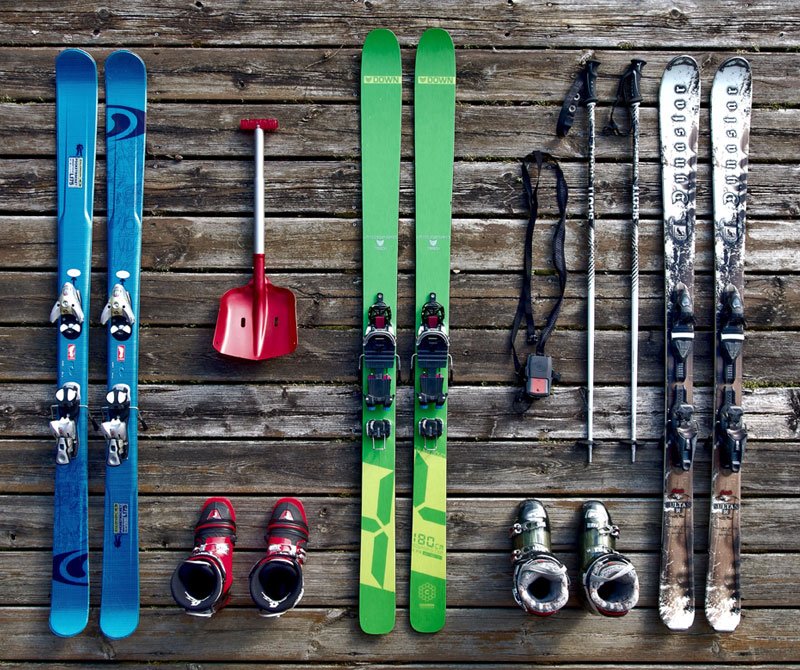
Wondering how to ship skis by courier? Nobody said that when driving or – as is increasingly common – flying for a winter holiday, you have to bring your ski equipment with you. Sometimes it can be troublesome, and you might worry about losing such luggage at the airport, for example. This is one of the reasons we ship skis by courier. Another reason might be selling skis, e.g. on an auction site: offering only personal collection will significantly limit the number of interested buyers, so the equipment needs to be shipped somehow. How to do this, given that skis are quite an unusually sized item and relatively valuable?
Nobody said that when driving or – as is increasingly common – flying for a winter holiday, you have to bring your ski equipment with you. Sometimes it can be troublesome, and you might worry about losing such luggage at the airport, for example. This is one of the reasons we ship skis by courier. Another reason might be selling skis, e.g. on an auction site: offering only personal collection will significantly limit the number of interested buyers, so the equipment needs to be shipped somehow. How to do this, given that skis are quite an unusually sized item and relatively valuable?
Choosing a courier company, shipping skis and ski equipment abroad
Shipping skis by courier can be challenging because not all courier companies accept parcels of such dimensions. Particularly very long skis, over 175 cm, will not be accepted everywhere. The first step should therefore be to check on the courier company's website whether your skis can be sent this way. It may also happen that a courier company will undertake transport, but only domestically – so you also need to check whether you can send skis abroad.
How to pack skis for courier shipping abroad
Like any shipment, skis need to be properly packed and protected against the effects of sorting, loading, reloading and unloading. Each stage of the journey means a greater or lesser risk of damage to the shipment, so the sturdier the packaging, the greater the certainty that the skis will arrive in perfect condition.
The best packaging is obviously a box in which the skis fit together with filler material. But where to find a box of such length? Contrary to appearances, this is not difficult at all. The term to search on Google is "telescopic box". After running the search, several places where such boxes can be purchased will appear. A box can be up to 2 m long.
Protecting bases, edges and bindings to avoid damaging expensive ski equipment
When thinking about how to ship skis by courier, it is worth paying more attention to protecting the most important parts of the skis, namely the bases, edges and bindings. Regardless of the type of packaging, skis should be placed with bases facing each other. Each pair should be secured with bubble wrap or cardboard placed between the bases, and the skis fastened e.g. by tightly wrapping them with packing tape. This way the skis will not move relative to each other and the bases will remain safe.
Instead of bubble wrap, you can of course use towels or other textiles, but bubble wrap not only provides the best protection but is also lightweight, which can affect the price you will pay for the service.
It is also worth securing the tips and ends of the skis by wrapping them with stretch film and adhesive tape. Bindings can be protected with pieces of sponge or polystyrene. If you have a ski bag, it is worth placing the skis in it. The secured skis are then placed in the box, and the interior is filled with filler material such as polystyrene packing peanuts to immobilise the contents. This way the skis will not move inside the box and the shipment will become more rigid – preventing deformation.
Poles should also be secured if they are to travel with the courier company too. Make sure they do not scratch anything and do not become deformed during shipping.
What if we do not have a box? What to pack skis in for shipping?
If you cannot find a cardboard box of the appropriate length, wrap the skis (secured as described above) carefully with cardboard so that it covers them along their entire length. You can use pieces of smaller boxes, appropriately cut. Compress the cardboard tightly with adhesive tape, wrap with stretch film and tape again. If you consider your skis to be a delicate item, you can use stickers (even downloaded from the internet and printed yourself) suggesting fragile contents, or even glass.
When our shipment is not a rectangular box, we send it as non-standard, which means it will be sorted and loaded manually rather than by machine. This ensures more gentle handling of the shipment.
Similar rules should also be followed when shipping other ski equipment, such as a snowboard. The best packaging is a box matched to the size. If we do not have one, we can create packaging by wrapping the equipment in strong cardboard, stretch film and self-adhesive packing tape – to protect the contents of the shipment from damage: scratches, dents, deformation, breakage, etc.